

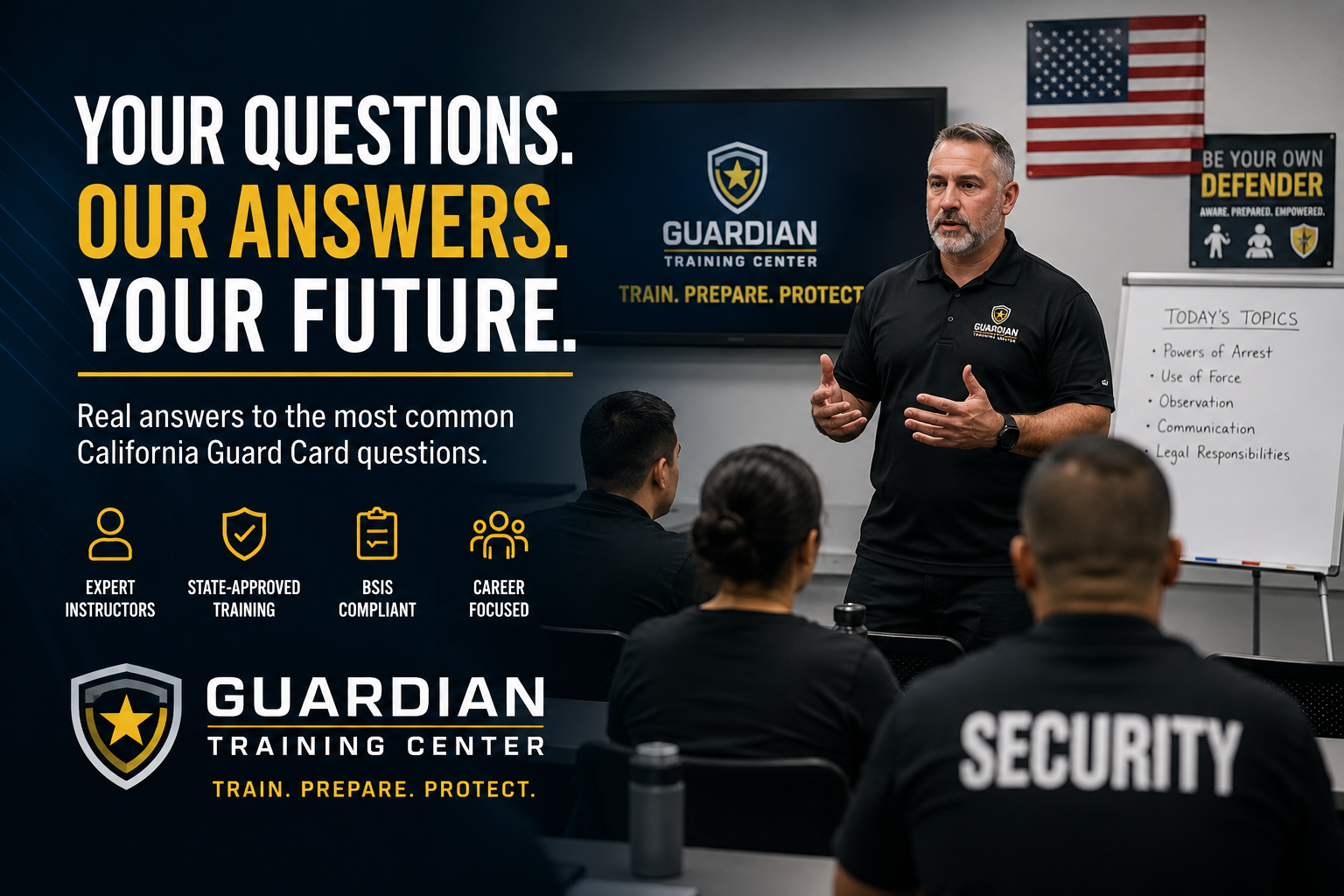
Walk into any Basic Guard Card class at Guardian Training Center and you will see the same thing every session. A room full of people with notebooks, nervous energy, and a long list of questions. Some have never worked in security before. Others are switching careers after years in a completely different field. Almost everyone wonders if they are ready.
We have taught this course enough times to know exactly which questions come up first. They are good questions. They come from people who take this career seriously and want to get it right from day one. Below are the answers we give most often, straight from the instructors who hear them week after week.
YOUR PATH TO BECOMING A CALIFORNIA SECURITY OFFICER
1️⃣ Take Your 8-Hour Basic Guard Card Course
↓
2️⃣ Submit Your BSIS Application
↓
3️⃣ Receive Your Guard Card
↓
4️⃣ Complete 16 Hours Within 30 Days
↓
5️⃣ Complete Final 16 Hours Within 6 Months
↓
6️⃣ Continue Building Your Skills
(Pepper Spray • Baton • Firearms • First Aid)
What Do I Actually Need To Get Started
Do I need experience or a background in security first
No prior experience is required. Guardian Training Center's Basic Guard Card course is built for beginners. Whether you are 19 years old and starting your first job or 45 and changing careers, the classroom starts at the same place for everyone.
What are the minimum requirements to enroll
To enroll in the Basic Guard Card course, you need to meet a few basic conditions:
- Be able to read and understand English, since the course ends with a written test
- Be prepared to pass a background check through the California Department of Justice and the FBI
- Bring valid identification for enrollment and testing
No personal or electronic translation devices are allowed during the exam, so English comprehension matters for passing the test itself.
What does the Basic Guard Card course actually cover
The course is 8 hours long and covers the foundational knowledge every licensed guard needs. Core topics include:
- Powers of Arrest
- Appropriate Use of Force
- Legal and ethical responsibilities of a security officer
- Communication and observation skills used on the job
What Is BSIS and Why Do California Security Guards Need It?
What is BSIS and why does it matter
BSIS stands for the Bureau of Security and Investigative Services. It is the state agency responsible for licensing every security guard in California. Without a BSIS Guard Card, you cannot legally work as a security officer in this state. Every part of your training, testing, and application process runs through this bureau.
How does AB 229 affect my training
AB 229 is recent legislation that changed how Power to Arrest and Use of Force training must be delivered. Students should know the following:
- At least half of this training must now be completed in person
- BSIS does not accept multiple training certificates for this course
- Multiple instructors cannot sign off on a single certificate
- Training must be completed with a single source trainer and facility
This last point trips people up more than any other. If you start your Power to Arrest training somewhere else, you cannot finish it at a different facility. Complete it in one place, with one trainer, from start to finish.
What happens after I finish the course
Once you complete your 8 hours of initial training, you are not done on your own. Our instructors walk you through:
- Completing the BSIS application paperwork
- Submitting your application correctly the first time
- Understanding state application fees, which are separate from the course cost
- Planning for your remaining required training hours
California security guards begin with eight hours of initial Power to Arrest and Appropriate Use of Force training. After registration or employment, they must complete 16 additional hours within the first 30 days and another 16 hours within the first six months, for 40 hours of required training in total.
Questions About the Training Day Itself
How long is the class and what should I expect hour by hour
The Basic Guard Card course runs 8 hours in a single day. Expect a mix of lecture, group discussion, and real scenario walkthroughs. Instructors break up the material so it does not feel like a long lecture from start to finish. There are breaks built into the schedule, and the pace is designed to keep everyone engaged rather than overwhelmed.
Is there a test, and what happens if I do not pass
Yes, there is a written exam at the end of the course. It covers the material from that day, particularly Powers of Arrest and Use of Force. If you do not pass on your first attempt, our instructors work with you to identify where you need more review. You are not simply sent home with no path forward. This is a common enough question that we want every student to hear the answer clearly before test day arrives.
What should I bring or wear
For the standard Basic Guard Card course, dress is casual and comfortable. If you are attending a more physical course later, like Tactical First Aid, gear expectations shift. Recommended items for hands-on courses include:
- Closed-toe athletic shoes or duty boots
- Comfortable, durable clothing, with pants preferred
- No loose accessories or jewelry
- A water bottle and any personal items needed for extended movement
For the Basic Guard Card class itself, simply bring your ID, something to write with, and your full attention.
What Can You Do After Getting Your California Guard Card?
What is the difference between an unarmed guard card and an Exposed Firearms Permit
A Guard Card allows you to work as an unarmed security officer. If you want to carry a firearm on duty, you need an additional credential called the Exposed Firearms Permit. This requires more training hours, a live-fire range qualification, and a valid psychological evaluation. It is a separate path with its own requirements, not an automatic upgrade from the Guard Card.
How do I move toward specialized certifications
Many students ask what comes after the Guard Card. There are several paths available depending on your career goals:
- Basic Pepper Spray certification
- Basic Weaponless Defense
- Basic Handcuffing
- BSIS Basic Baton Course
- BSIS Exposed Firearms Certification
How soon can I start working after I finish training
Completing the initial eight-hour course and submitting an application do not, by themselves, authorize someone to begin regulated security work. Students should verify that BSIS has approved their security guard registration. While waiting for the physical card, an approved registrant may use the Bureau’s online license verification together with valid photo identification, subject to current BSIS requirements and employer policies.
How Do I Keep My California Security Certifications Current?
How often do I need to requalify
Requirements vary depending on your certification. Armed professionals with an Exposed Firearms Permit must requalify on a regular schedule to keep their permit active. Guard Card holders also have ongoing training hour requirements during their first year. Staying current is part of the job, not an optional extra.
What happens if my permit or certification lapses
This is one question we want every student to take seriously. If your Exposed Firearms Permit lapses, you may be required to complete the full initial course again rather than a shorter renewal. Waiting until the last minute is one of the most common and avoidable mistakes in this field. Plan ahead and treat your renewal date as a firm deadline.
Can GTC help me stay on track long term
Yes. Our instructors do not disappear once your class ends. We help students plan renewal timing, track certification deadlines, and choose which additional courses make sense for their career goals. This career works best as a long term relationship with a training provider you trust, not a one time transaction.
Starting With Confidence, Not Confusion
Every licensed security professional working today once sat exactly where you are sitting now, holding a list of questions and wondering if they were asking too many of them. They were not. The guards who ask the most questions early on tend to be the ones who take the job the most seriously later.
Curiosity is not a weakness in this field. It is a sign that you understand what is actually at stake in security work and you want to do it right. The requirements can feel like a lot to track at first, but they exist for a reason, and every one of our instructors has walked new students through this exact process many times before.
Ready to Ask Us Your Questions in Person
If you still have questions of your own, that is exactly what our instructors are here for. Guardian Training Center offers hands-on, instructor-led training that walks you through every requirement step by step, from your first class to your first shift.
Reach out to our team or register for an upcoming Basic Guard Card course today.
📞 510-626-4940 🌐 guardiantc.com Register here: execushield.enrollware.com/schedule#ct337201


.png)
.svg)